
How Much Does a Wardrobe Weigh and How It Affects Delivery
Weight estimates for custom chipboard wardrobes, palletized delivery explained, floor load considerations, wall anchoring requirements, and pre-integrated connectors for easier assembly.
The weight of custom furniture is a subject few buyers consider during configuration, but it directly influences delivery cost, shipping method, assembly requirements, and even long-term safety. This guide provides concrete weight estimates, explains why Téchne delivers on pallets, and what to check before ordering a large wardrobe.
Melamine Chipboard Weight: The Real Numbers
Melamine chipboard (particleboard) used in furniture production has an average density of ~650 kg/m³. This means a standard 18 mm thick panel weighs approximately 11.7 kg per square meter of surface. With these figures, we can calculate the weight of any wardrobe.
Weight Estimates by Common Dimensions
- Wardrobe 100 x 220 x 60 cm (2 columns) — approximately 70-85 kg total (structure + shelves + HDF back)
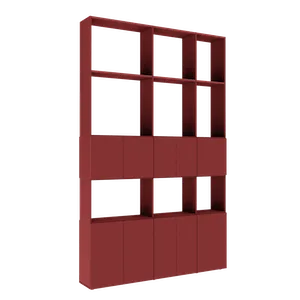
- Wardrobe 150 x 236 x 60 cm (3 columns) — approximately 100-120 kg
- Wardrobe 200 x 240 x 60 cm (4 columns) — approximately 130-160 kg
- Wardrobe 250 x 260 x 60 cm (5 columns) — approximately 170-210 kg
- Wardrobe 300 x 260 x 60 cm (6 columns) — approximately 210-260 kg
These estimates include the carcass (sides, top, base), vertical dividers, standard shelves, and HDF back panel. They do not include doors (which add significantly), drawers with hardware, or accessories.
What Adds Extra Weight
The final configuration can be 20-50% heavier than the base structure, depending on chosen options:
- Hinged chipboard doors — each 60 x 236 cm door adds ~8-10 kg
- Mirror doors — the mirror adds ~4-6 kg per door compared to the non-mirror variant
- 18 mm laminated back panel — 4-5 times heavier than standard HDF (see the full comparison)
- Interior drawers — each drawer with Hafele slides adds 3-5 kg
- Additional shelves — a 50 x 55 cm shelf adds ~2-3 kg
- Extra panels/fillers — each decorative panel adds depending on size, from 2 kg (small filler) to 10+ kg (additional side panel)
How It Is Delivered: Flat-Pack Palletized
Téchne furniture is not delivered assembled — it would be impossible to transport a 260 cm tall, 200+ kg wardrobe through doors and up staircases. Instead, all components are delivered flat-pack, organized and secured on pallets.
What Palletized Delivery Means
- Individual components — each panel (side, top, base, shelf, divider) is individually wrapped in corrugated cardboard with corner protection
- Pallet grouping — components are logically grouped and secured on standard pallets (120 x 80 cm) with stretch film for stability
- Clear labeling — each piece is numbered and labeled according to assembly instructions
- Tail-lift transport — the delivery truck has a hydraulic tail lift for ground-level unloading, no forklift needed
Why Téchne Delivers Palletized (Not in Parcels)
Some manufacturers deliver furniture in standard parcels via courier. Téchne chose premium palletized delivery for safety reasons:
- Superior protection — the rigid pallet prevents bending and damage to long panels (a 260 cm side panel is extremely vulnerable in a soft parcel)
- Controlled handling — pallets are handled with specialized equipment, not tossed in sorting depots
- Inspection at delivery — you can visually inspect every component upon delivery, before signing
- Zero transport damage — the damage rate for palletized delivery is under 1%, compared to 5-10% for standard parcel delivery
Yes, palletized delivery costs more than a parcel via express courier. But the cost of a damaged piece — re-production, re-delivery, assembly delay, stress — far exceeds the shipping price difference.
Floor Load: What Can Your Floor Handle?
A large wardrobe can weigh 200-300 kg with all its contents. Is your floor ready? Here is what you need to know:
Reinforced concrete (apartment buildings)
Reinforced concrete floors typically support 200-300 kg/sqm of useful load (per Romanian building codes). A 300 cm wide x 60 cm deep wardrobe has a base area of 1.8 sqm, so even at 300 kg, the load is ~167 kg/sqm — comfortably within limits. No structural concerns.
Wooden beam floors (old houses)
Here the situation differs. Wooden beam floors may have lower capacity, especially between beams. Recommendations:
- Position the wardrobe perpendicular to the beams, not parallel — this distributes weight across multiple beams
- For wardrobes over 200 kg, consult a structural engineer if the floor creaks or feels springy
- Add a distribution board (OSB or chipboard) under the wardrobe if the floor is uneven
Floating floors (laminate, engineered wood)
Floating floors are not a structural problem, but the heavy wardrobe weight can permanently mark them. Solutions:
- Use adjustable feet that distribute weight across points
- Place protective pads under the feet
- Never drag the wardrobe on the floor — always lift it
Wall Anchoring: Why It Is Mandatory
Any wardrobe taller than 200 cm must be anchored to the wall, regardless of weight. The reason is simple: the high center of gravity makes the wardrobe vulnerable to tipping, especially when doors are open (lever effect).
- Concrete/brick wall — 8-10 mm metal anchors with minimum 60 mm screws. At least 2 fixing points on each side panel touching the wall
- Drywall — special toggle or molly anchors with larger surface distribution. For heavy wardrobes, fix directly into the metal studs behind the drywall
- Aerated concrete (AAC/ytong) — special spiral anchors for AAC, never standard plugs that pull out easily from the porous material
Anchoring prevents serious accidents, especially in homes with children. Do not skip this step, no matter how stable the wardrobe seems at first glance. For fastening details, also read the DIY assembly guide.
Extra Panels and Fillers: Weight Impact
When configuring a full wall wardrobe (including beam adaptation), you often add extra panels — side fillers to cover gaps between wardrobe and wall, visible decorative panels, or top panel extensions.
Weight impact:
- Side filler 5 x 260 cm — ~1.5 kg
- Decorative side panel 60 x 260 cm — ~10 kg
- Top panel extension 60 x 60 cm — ~2.5 kg
- Plinth (base) 200 x 10 cm — ~1.5 kg
In total, extra panels typically add 5-15 kg to the final weight — not structurally significant, but relevant for delivery cost.
Pre-Integrated Connectors: Faster Assembly, Less Weight
Téchne furniture uses pre-integrated connectors (Minifix, rafix, and wooden dowels) factory-installed, not conventional screws requiring on-site drilling. The advantages:
- Faster assembly — pieces join by insertion and rotation, no drill needed
- Superior precision — holes are CNC-machined, alignment is perfect
- Slightly less weight — connectors replace screws + metal brackets, saving a few hundred grams per joint
- Disassembly possible — if you move, you can disassemble and reassemble the wardrobe without damaging the panels
Téchne also offers step-by-step assembly video tutorials for each furniture type, making self-assembly accessible even for beginners.
Content Weight: How Much Does a Full Wardrobe Weigh
The weight of an empty wardrobe is only part of the equation. A wardrobe full of clothes, bedding, and accessories weighs significantly more. Indicative estimates:
- Clothes on hangers — one linear meter of clothing rail with hanging clothes weighs approximately 15-25 kg (summer) or 25-40 kg (winter clothes, coats)
- Shelf with folded linen — a full 50 x 55 cm shelf weighs 5-10 kg
- Drawer with underwear — a full drawer weighs 3-7 kg
- Storage boxes on upper shelves — 5-15 kg per box, depending on contents
A medium 200 cm wardrobe, fully loaded, can reach 250-350 kg total (structure + contents). This is important to know for floor load calculation and wall anchoring — a full wardrobe is much more stable (lower center of gravity) than an empty one with doors open.
Moving With Custom Furniture
A frequent question: what happens if I move? Can custom furniture be disassembled and reassembled? The short answer: yes, if it uses pre-integrated connectors, not glue or nails.
Téchne furniture is designed for disassembly and reassembly:
- Minifix/Rafix connectors unlock with a 90-degree turn without damaging the panels
- Wooden dowels are removed by gentle pulling — they are not permanently glued
- Panels are robust and withstand 2-3 assembly-disassembly cycles without visible wear
- Hardware (hinges, slides) can be disassembled and reassembled without losing functionality
Upon reassembly, the only challenge is adapting to the new space. If the new wall has exactly the same dimensions, the wardrobe installs identically. If dimensions differ, you can order new fillers from Téchne to compensate for the difference — the rest of the furniture remains intact.
Important tip: when disassembling, photograph each stage and additionally number the pieces (with adhesive tape and marker). Keep all hardware in a labeled bag. These simple precautions turn reassembly into a process of a few hours, not a few days.
Practical Summary
Your wardrobe weight depends on dimensions, materials, and accessories. As a guide:
- Small wardrobe (100-150 cm) — 70-120 kg
- Medium wardrobe (200 cm) — 130-170 kg
- Large wardrobe (250-300 cm) — 180-260 kg
- Add 20-40% for doors, drawers, and accessories
Téchne palletized delivery ensures complete component protection, and wall anchoring is mandatory for any tall wardrobe. Pre-integrated connectors make assembly simpler and more precise than furniture with conventional screws. Before production and delivery, every order is manually reviewed by an operator who confirms all details — including transport specifications.
Configure your wardrobe and see the estimated weight: Open the wardrobe configurator