
Standard Wardrobe Dimensions — Complete Tables by Room Type
Complete tables with recommended wardrobe dimensions for each room type: bedroom, hallway, walk-in closet, kids' room. Depths, heights, widths, and clearance spaces.
Before ordering or configuring a wardrobe, you need to know which dimensions work for your space. Whether you are furnishing a bedroom, entrance hallway, dedicated walk-in closet, or kids' room, the optimal dimensions differ significantly. In this guide, we have compiled complete tables with recommended dimensions, minimum clearance spaces, and practical tips for each room type.
General sizing principles
Before diving into room-specific details, a few universal rules:
- Minimum depth for hanging clothes: 55 cm (ideal 60 cm). Below 55 cm, hangers do not position correctly and clothes get wrinkled
- Depth for shelves only: 30-45 cm is sufficient if the wardrobe is only for shelf storage (shoes, linens, boxes)
- Front clearance space: minimum 70 cm for hinged doors (at full opening),
- Minimum ceiling distance: 0 cm with custom wardrobe (made to exact size), 5-15 cm with standard wardrobe
- Optimal clothing rail height: 170 cm from floor for comfortable access
Master bedroom
The master bedroom requires the most storage space — two people, four seasons of clothing, bedding, and accessories.
Recommended bedroom wardrobe dimensions:
- Minimum width: 200 cm (for 2 people, minimum 100 cm per person)
- Recommended width: 250-300 cm (allows clear zone separation)
- Height: 235-260 cm (floor to ceiling or 3-5 cm below ceiling)
- Depth: 60-65 cm (standard for clothing rail + back space)
Typical compartmentalization for 250 cm width:
- Column 1 (60 cm): long clothing rail — dresses, coats, jumpsuits
- Column 2 (65 cm): short clothing rail top (shirts, blouses) + 3 shelves below
- Column 3 (60 cm): 4 interior drawers (underwear, accessories, folded t-shirts)
- Column 4 (65 cm): short clothing rail top + 3 shelves below
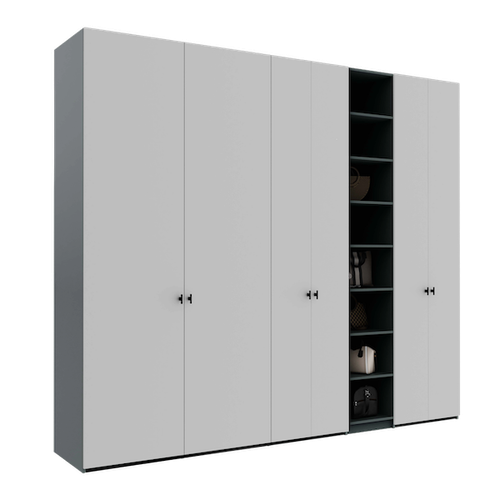
You can visualize and customize exactly this configuration in the Téchne configurator. Read more about interior organization.
Entrance hallway
The hallway is usually the most restrictive space — narrow, with access doors and limited space for wardrobe door opening.
Recommended hallway wardrobe dimensions:
- Minimum width: 100 cm (for a single person)
- Recommended width: 150-200 cm (allows jacket zone + shoes)
- Height: full available height (usually 245-260 cm)
- Depth: 40-60 cm (40-45 cm if hallway is very narrow — use a rail parallel to the back)
Important: in narrow hallways under 120 cm usable width, choose narrow hinged doors or open shelving — narrow hinged doors require less opening spaceComplete hallway wardrobe guide.
Walk-in closet
A walk-in closet offers the most configuration freedom but requires careful planning of circulation space.
Recommended dimensions:
- Minimum room for walk-in closet: 150x200 cm (single wall configuration)
- Ideal space: 200x250 cm (two facing walls with 80 cm corridor)
- Wardrobe depth: 55-60 cm (on each side)
- Minimum circulation corridor: 70 cm (for comfortable movement and drawer opening)
- Height: full available height, including top panel to ceiling
L or U configuration: for walk-in closets over 6 sqm, you can configure wardrobes on 2 or 3 walls. Each wall can have its own configuration — one wall for long clothes, one with shelves and drawers, one with shoe storage. Complete walk-in closet guide.
Kids' room
Furniture for kids' rooms must be accessible to the child but grow with them.
Recommended kids' room wardrobe dimensions:
- Width: 120-180 cm (sufficient for one child, with room to grow)
- Height: 200-240 cm (accessible clothing rail at 120-140 cm; upper zone used for seasonal storage by adults)
- Depth: 55-60 cm (standard)
Child-specific tips:
- Clothing rail at 120-130 cm height for ages 4-8, at 140-150 cm for ages 8-12
- Drawers in the lower zone (below 80 cm) — children can access them independently
- Open shelves at accessible height for toys and books
- Upper zone (above 160 cm) with doors — seasonal storage managed by parents
Read the complete kids' room furniture guide.
Guest room / second room
The secondary room needs a more compact but functional wardrobe.
Recommended dimensions:
- Width: 120-180 cm
- Height: 220-260 cm
- Depth: 55-60 cm
A 150 cm wide wardrobe with one rail column and one with shelves + drawers covers the basic needs of a single person.
Attic and spaces with sloped ceilings
Attics require wardrobes with the top panel adjusted to the ceiling slope. Standard dimensions do not work here — you need centimeter-level configuration.
Specific dimensions:
- Maximum height: variable (tallest point of the slope, usually 240-270 cm)
- Minimum height: minimum 100 cm (below this, the space is no longer useful for a wardrobe)
- Depth: 45-60 cm (reduced if the ceiling slope requires it)
The Téchne configurator allows adjusting the top panel on each column independently, adapting to any attic geometry. Complete attic wardrobe guide.
Summary dimensions table
For quick reference:
- Master bedroom: 200-300 cm (W) x 235-260 cm (H) x 60-65 cm (D)
- Entrance hallway: 100-200 cm (W) x 245-260 cm (H) x 40-60 cm (D)
- Walk-in closet: full wall x full height x 55-60 cm (D), corridor min 70 cm
- Kids' room: 120-180 cm (W) x 200-240 cm (H) x 55-60 cm (D)
- Guest room: 120-180 cm (W) x 220-260 cm (H) x 55-60 cm (D)
- Attic: variable x variable x 45-60 cm (D)
Clearance spaces and ergonomics
Wardrobe dimensions do not exist in isolation — they must be correlated with the space around them. Here are the essential clearance rules:
- In front of hinged doors: minimum 70 cm free (for full 90-degree door opening). If the door opens to 110 degrees (Hafele standard), you need 75-80 cm
- In front of drawers: minimum 60 cm (for full drawer extension + access space). With full-extension slides, the drawer comes completely out of the body
- Passage corridor next to wardrobe: minimum 60 cm for side passage, 80 cm for comfort. Below 50 cm, circulation becomes difficult
- Distance from bed: if the wardrobe is on the same wall as the bed, leave at least 50 cm between the bed edge and wardrobe for comfortable access
Common sizing mistakes
From our experience, the most frequent wardrobe sizing mistakes are:
- Insufficient depth — a 50 cm deep wardrobe seems enough, but after subtracting back panel thickness (18 mm or 3 mm) and door thickness (18 mm), only 46-48 cm remain usable. Standard hangers are 44 cm wide and need at least 3 cm back clearance, so the real minimum is 55 cm
- Height too low — buying a 200 cm wardrobe in a room with a 265 cm ceiling leaves 65 cm of empty space above. A custom 262 cm wardrobe (with 3 cm mounting clearance) recovers the upper zone for seasonal storage
- Width without column calculation — a 180 cm wardrobe seems generous, but divided into 3 columns, each has 60 cm — exactly the minimum for a clothing rail. With 200 cm you get 3 columns of about 67 cm each, much more comfortable
- Ignoring beams and installations — outlets, switches, gas pipes, or air conditioning ducts may require cutouts or dimension changes. Measure and note all obstacles before configuring. Ceiling beam wardrobe guide
How to measure your space correctly
Before configuring, measure with a tape measure or laser distance meter:
- Width — measure at 3 different heights (floor, middle, ceiling). Walls are never perfectly straight; take the minimum value and subtract 1-2 cm
- Height — measure at 3 points (left, center, right). Ceilings can vary by 1-3 cm. Take the minimum value
- Available depth — from wall to obstacle (bed, door, window). Also check near the ceiling (beams, ducts)
- Obstacles — note the positions of outlets, switches, radiators, pipes, and any fixed element
Special dimensions for chipboard and MDF
Beyond space dimensions, you must also consider material limitations. Melamine chipboard panels come in standard factory sizes — usually 2800x2070 mm or 2800x1830 mm. If your wardrobe exceeds these dimensions, panels are joined with connectors. At Téchne, this joint is invisible thanks to pre-integrated connectors and precise CNC alignment.
Painted MDF doors have similar limitations — a hinged door should not exceed 60 cm width (the weight becomes excessive for hinges, even Hafele ones). For wide wardrobes, multiple narrower doors are recommended instead of few wide doors.
Narrow hinged doors (30-40 cm) are ideal for tight spaces and offer complete interior access.
All these limitations are automatically managed by the Téchne configurator — if you enter a dimension that exceeds material limits, the system warns you and suggests alternatives.
Dimensions for interior accessories
Interior compartmentalization imposes its own dimensional rules:
- Clothing rail: minimum column width for a rail is 45 cm. Below this, hangers block each other. Ideal: 55-70 cm per column with rail
- Pantograph (pull-down rail): requires minimum 85 cm free height in the column and 45 cm width. Mounted at heights of 180-240 cm
- Interior drawers: the useful drawer depth is the wardrobe depth minus 8-10 cm (for slides and back). A 60 cm deep wardrobe will have drawers with ~50 cm useful depth
- Shelves: minimum vertical distance between shelves is 20 cm (for books) and recommended maximum 45 cm (for folded clothes). Between 30-35 cm is the universal standard
- Trouser rack: requires minimum 60 cm width and 55 cm depth
In the Téchne configurator, interior accessories are positioned visually in 3D — you see exactly where each element is and how it relates to the column dimensions. Interior wardrobe organization guide.
The Téchne configurator: any dimension, to the centimeter
Regardless of which room you are furnishing, the Téchne configurator supports dimensions up to 825 cm width x 275 cm height x 80 cm depth, with centimeter precision. You are no longer limited to standard sizes — configure exactly what you need, see the price in real time, and visualize the result in 3D. The system automatically checks every dimension you enter — if a value exceeds structural limits, the configurator warns you immediately, preventing design mistakes.
Configure the wardrobe to your exact dimensions