
Room Divider Bookshelf: How to Partition Space Without Walls
Practical guide for room divider bookshelves: how to partition an open space with functional furniture, double-sided access, recommended dimensions, and integration into living rooms or bedrooms.
Modern apartments have generous open spaces, but sometimes you need a visual boundary between zones without building a wall. A room divider bookshelf is the perfect solution: it functions simultaneously as a partition wall, storage space, and decorative element. Unlike a traditional wall, a divider bookshelf preserves natural light, allows air circulation, and can be accessed from both sides.
When you need a room divider
The most common situations where a room divider is useful:
- Living + dining — you delineate the conversation area from the dining area while maintaining the feeling of open space
- Living + office — you create a semi-private work corner in an open space without blocking light
- Bedroom + dressing — you replace a partition wall with furniture that offers storage on both sides
- Children's room — you divide a large room into two zones (play and study, or two personal zones for siblings)
Recommended dimensions and proportions
Divider dimensions depend on available space and the desired level of privacy. A few recommendations:
- Height — a 140-160 cm divider provides visual delineation while maintaining openness to the ceiling. A 220-240 cm one (full height) offers maximum privacy but completely divides the room
- Width — usually covers 60-80% of the room width, leaving a free passage on one or both sides
- Depth — between 30 and 40 cm, sufficient for books and decorative objects without taking up too much usable area
Double access: functional from both sides
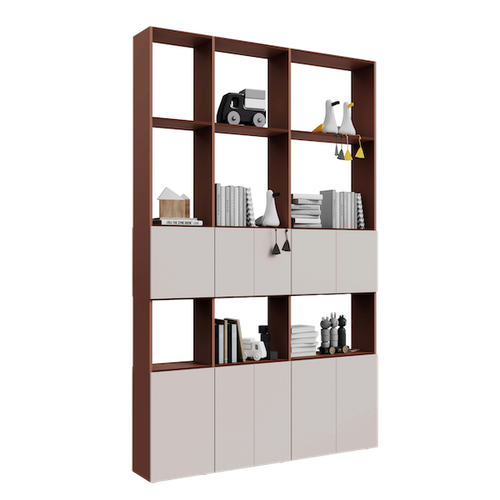
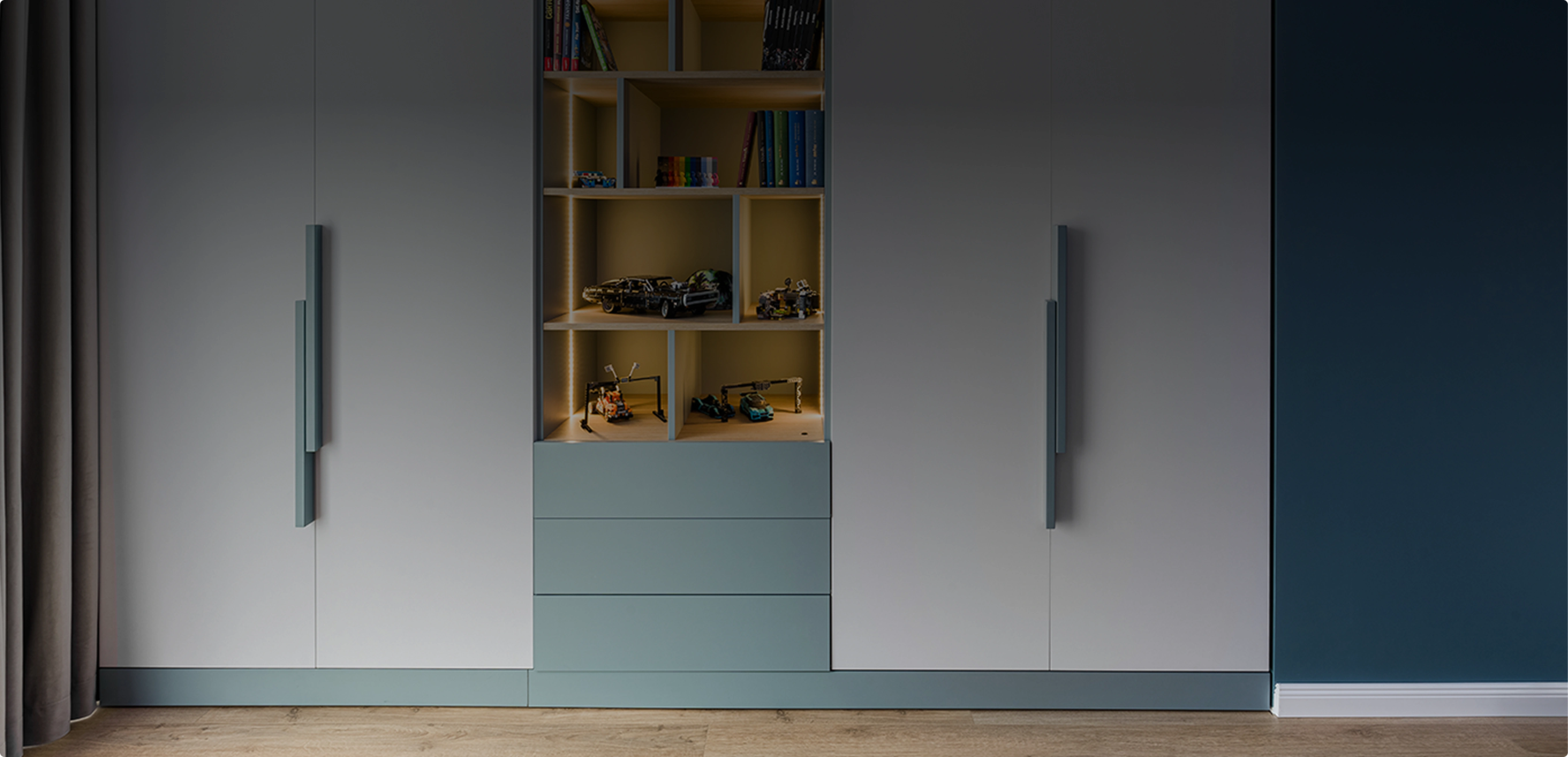
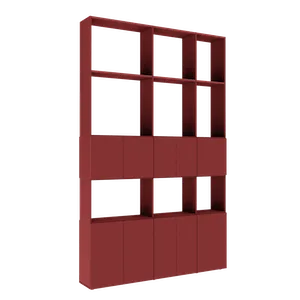
The great advantage of a divider bookshelf over a wall is that you can use both faces. The design with open shelves (no backing) offers total access from both directions and maintains visual transparency. Alternatively, you can combine open shelves in the upper part with closed cabinets in the lower part — the cabinets offer hidden storage while the upper shelves let light pass through.
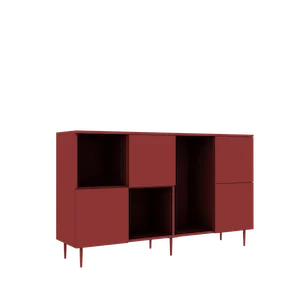
For an even more interesting effect, you can alternate open niches with closed compartments asymmetrically. Viewed from the living room, you see certain niches; viewed from the dining room, you see others. This play of solid and void creates a dynamic architectural element.
Transparency levels
The degree of openness dramatically influences spatial perception:
- Completely open (no backing) — maximum transparency, ideal for small spaces where you do not want to lose the feeling of openness. Objects are visible from both sides
- Partially closed — backing on 50-60% of the surface, the rest open. Offers a balance between privacy and light
- Full backing with decorative niches — nearly complete visual separation, but with rectangular windows that allow light to pass through
Integration into the modern living room
A room divider should not look like a piece of furniture added as an afterthought. Correctly integrated, it becomes a central element of interior design. A few integration ideas:
- LED strips integrated into niches, with warm light (3000K), create a gallery effect and illuminate displayed objects
- The divider base can include a plinth that aligns with the room baseboards, creating visual continuity
- The divider color can match the rest of the room furniture or, conversely, serve as a contrasting accent
- A horizontal top at 90-100 cm height can function as a bar or console, adding an additional function
Stability and mounting
A tall room divider (over 160 cm) requires proper mounting. Unlike a wardrobe that leans against a wall, the divider stands freely in space and must be anchored:
- Ceiling mounting with hidden metal profiles — the most stable solution
- Floor mounting with adjustable metal supports
- Wide base (40 cm depth) that ensures stability through its own weight
- Lateral wall mounting on one side, if the design allows
Hafele hardware offers professional mounting solutions that are completely invisible after installation, ensuring both stability and the aesthetics of the ensemble.
A room divider bookshelf transforms an open space into an organized and visually interesting environment, without the compromise of a fixed wall. Configure your ideal divider with exact dimensions and choose the right transparency level in the Téchne configurator.
Practical uses of the divider
A room divider bookshelf is not just a design element — it is furniture with concrete practical applications. In a large living room, it can delineate the conversation area from the study or home office zone, creating a semi-private workspace without renovations. In a bedroom, it can replace the wall between the sleeping area and the wardrobe, offering storage on both sides. In a studio apartment, a 140 cm tall divider separates the sleeping zone from the living zone, preserving the open-space feeling and natural light.
How to configure the divider in the Téchne configurator
In the Téchne divider configurator, you choose exact dimensions (height, width, depth), decide which compartments are open and which are closed, and experiment with the transparency level. You can add Hafele hinged doors on the lower compartments and adjustable shelves on the upper ones. The 3D preview lets you rotate the piece and see how it looks from both sides. The price updates in real time, and production takes 2-3 weeks.