
Kids and youth room furniture: safety, durability, and design that grows with them
Complete guide for kids and youth bedroom furniture. Safety tips, durable materials, colours, and age-adapted compartments for children's rooms.
A child's room is probably the most dynamic space in the house. Over 10-15 years, it transitions from nursery to preschooler's room, then to a school-age room, and finally to a teenager's room. The furniture must keep pace with these transformations — or, even better, be designed from the start to adapt.
Safety: the number one priority
Regardless of the child's age, furniture in their room must follow fundamental safety rules:
- No sharp corners — all accessible edges should be rounded or protected with 2 mm ABS edging, eliminating the risk of cuts.
- Mandatory wall fixing — any wardrobe, shelf, or bookcase over 80 cm tall must be fixed to the wall with screws and anchors. Children climb — this is a fact, not a possibility.
- Soft-close hinges — slamming doors are a real danger for small fingers. Hafele soft-close hinges prevent sudden closing.
- Anti-fall drawer locks — Hafele slides with stoppers prevent the drawer from falling out completely when pulled. Essential for toddlers who open drawers out of curiosity.
- Non-toxic materials — E1-class chipboard (minimal formaldehyde emission) and water-based paints are the standard for children's furniture.
Age-based compartments
Storage needs change dramatically as the child grows. A smart wardrobe anticipates these changes:
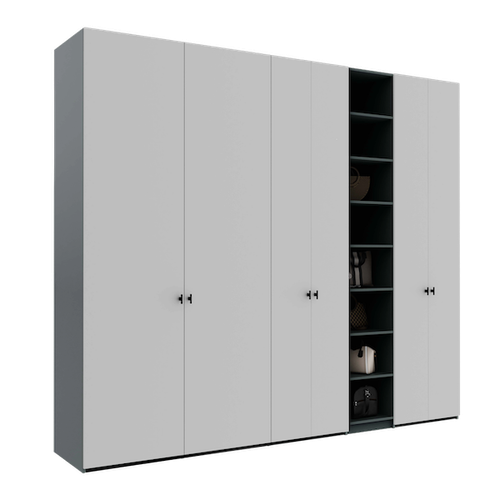
Ages 2-5 (preschool) — the priority is toys and books. Low shelves (under 100 cm) that the child can access independently, colourful pull-out baskets for toys, and a clothes rail at 90-100 cm height to encourage autonomy. Clothes are small, so a high rail is unnecessary.
Ages 6-11 (school) — backpacks, school books, and sports equipment appear. Adjustable shelves become essential. The clothes rail moves up to 120-140 cm (the child grows, so do the clothes). Drawers for linens and accessories replace toy baskets.
Ages 12-18 (teenager) — the wardrobe diversifies, gadgets appear, thicker books, hobbies. Clothes rail at standard height (160-170 cm), multiple interior drawers, a lockable compartment for personal items. The room becomes a private space, and the furniture must reflect this.
Colours and finishes: what works long-term
The temptation to decorate a child's room in bright colours — pink, deep blue, lime green — is strong. But these colours become inadequate in 3-4 years when the child's preferences change. Our recommendation:
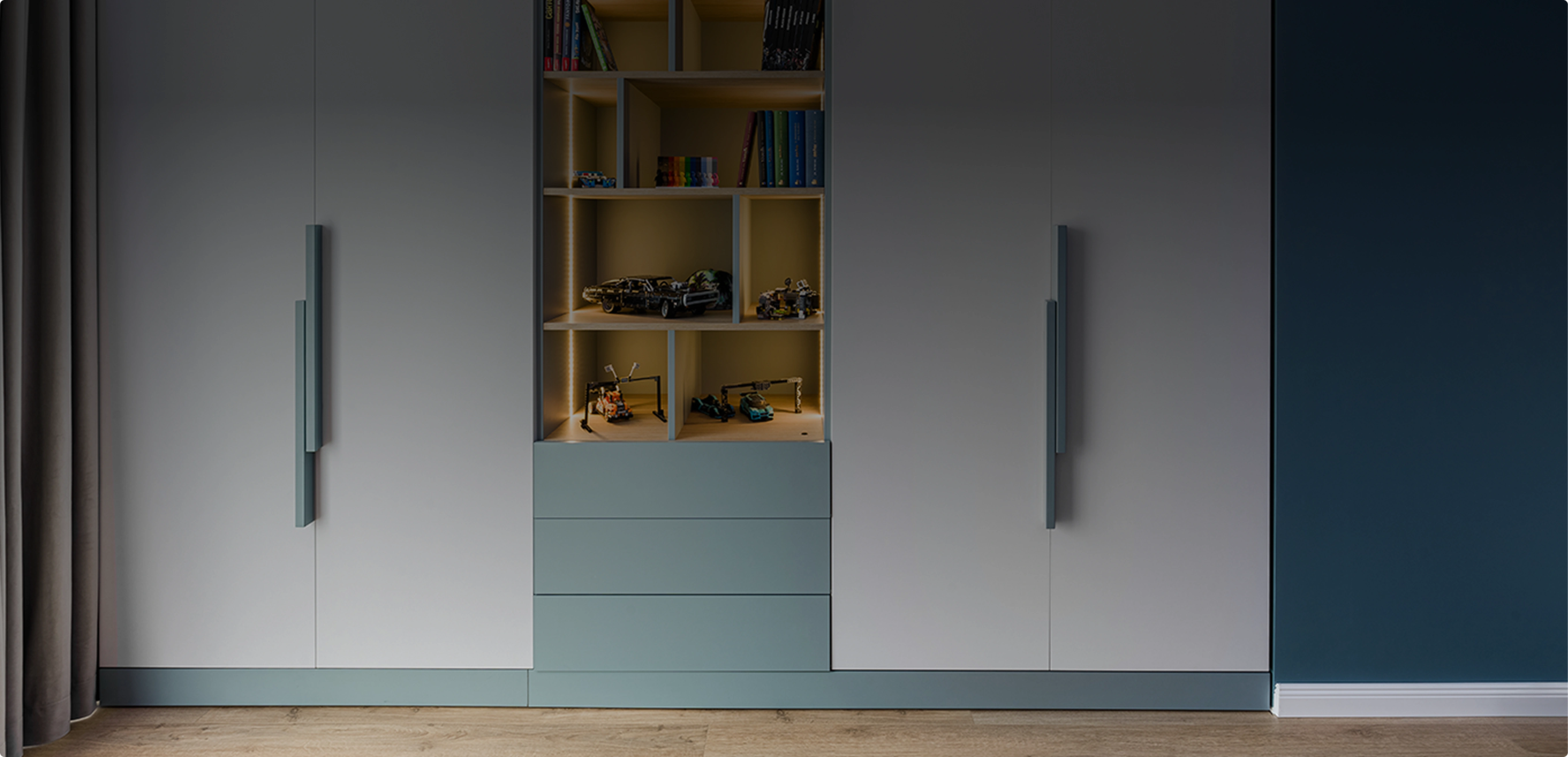
- Neutral-coloured bodies — white, beige, light grey, or natural oak. These withstand any style change.
- Colour accents on easily changeable elements — handles, baskets, shelf interiors, door posters. When the child grows, change the accents, not the wardrobe.
Durability: furniture that withstands play
A child's room is subject to greater mechanical stress than any other room. Thrown balls, chairs pushed into wardrobes, drawers opened with enthusiasm — all of these demand a lot from furniture. That is why:
- 18 mm melamine chipboard for bodies (not 16 mm — the difference in strength is significant).
- 8 mm back panel fixed in a groove (not stapled on, which detaches over time).
- Hafele full-extension slides with 30 kg capacity per drawer — they hold even when a child sits on the open drawer.
Desk and integrated study area
Besides the wardrobe, a child's room needs a well-organised study area. A desk integrated into the furniture ensemble — with a shelf above, side drawers, and cable management for laptop and lamp — creates a coherent and efficient space. The ideal desk depth is 60 cm, with a minimum width of 100 cm.
Furniture that grows with your child
Investing in quality furniture for a child's room does not happen three times (preschool, school, teenager). It happens once, with a custom wardrobe that reconfigures as needs evolve. Adjustable shelves, repositionable clothes rails, and modular compartments allow transformation without replacement.
Ready to design the perfect room for your child? Configure kids room furniture here. The configurator automatically checks the structural integrity of each piece — it won't let you choose dimensions or combinations that don't meet safety standards.
Room divider for siblings
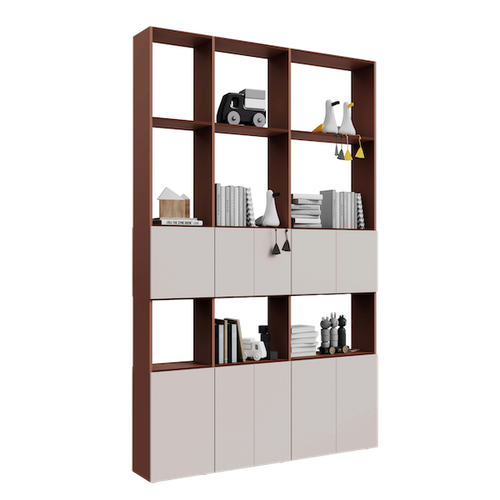
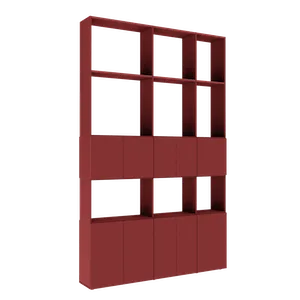
When two children share the same room, a bookshelf room divider can create two distinct zones without building a wall. The divider offers storage on both sides — one side for each child — and maintains natural light circulation through open niches in the upper section. Each child receives their own private space with shelves for books and personal items, without making the room feel enclosed or dark.
Organisation with interior accessories
Beyond shelves and clothes rails, interior accessories make the difference in daily organisation. Pull-out metal baskets are ideal for toys and linens — the child can see the contents at a glance and put things back independently. Compartmentalised drawer organisers help sort small accessories: hair ties, jewellery, figurines, pencils. Backpack holders, mounted on the inner side of the wardrobe, free up the room floor and maintain order. All these accessories can be configured directly in the Téchne configurator, with real-time 3D preview.