
Complete Guide: How to Choose the Perfect Wardrobe for Your Home
Everything you need to know about dimensions, materials and compartments to choose the ideal wardrobe.
Choosing a wardrobe is not just an aesthetic decision — it's a long-term investment in the comfort and organization of your home. A well-chosen wardrobe completely transforms storage space and simplifies your daily routine.
1. Dimensions Matter More Than You Think
The first step is to accurately measure the available space. Don't limit yourself to width and height — depth is equally important. A standard wardrobe is 60 cm deep, but if you have a narrower space, you can opt for 45-50 cm (ideal for hallways or small bedrooms).
Tip: Leave at least 5 cm between the wardrobe and ceiling for ventilation and easy installation.
2. Materials Make the Difference
The most common wardrobe materials are:
- Melamine chipboard — the most popular, excellent quality-price ratio, available in hundreds of colors and textures
- Painted MDF — smooth surface, perfect for modern fronts, available in any RAL color
- Natural veneer — premium look with authentic wood texture, ideal for classic or Scandinavian styles
Hardware is equally important: soft-close hinges, full-extension drawer slides and quality internal organization systems make the difference between a wardrobe that lasts 5 years and one that lasts 20.
3. Smart Compartmentalization
A well-compartmentalized wardrobe saves time and space. Here are the basic rules:
- Upper zone (above 180 cm) — bedding, seasonal items, storage boxes
- Central zone (80-180 cm) — clothes on hangers, clothing rail at ~170 cm height
- Lower zone (below 80 cm) — drawers for underwear, folded pants, accessories
For a 2-meter wide wardrobe, we recommend at least 3 compartments: one with a rail for long clothes, one with a rail for short clothes + shelves below, and one with drawers and shelves.
4. Door Types
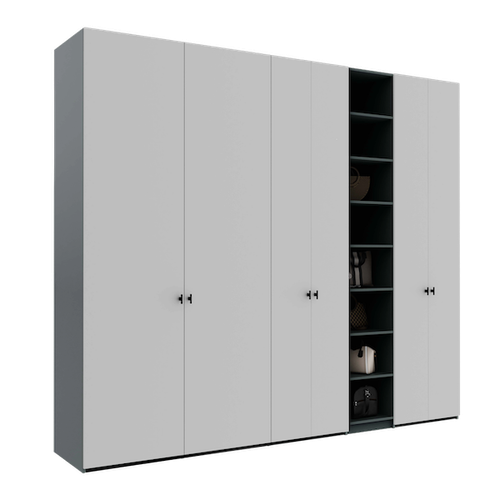
Hinged doors — classic, accessible, allow viewing the entire interior. Require opening space in front of the wardrobe.
No doors (walk-in) — for spacious dressing rooms, total access, premium look.
5. Custom vs. Standard
A wardrobe configurable to the centimeter fits perfectly in any space, including attics, niches or walls with irregular corners. With an online configurator, you can visualize exactly how your wardrobe will look, with all compartments, colors and accessories chosen — and see the price in real time.
6. Materials in Detail: What We Use at Téchne
At Téchne, the wardrobe body is made from 18 mm melamine chipboard — the standard thickness in quality furniture manufacturing. 18 mm chipboard provides superior structural rigidity compared to the 15-16 mm boards frequently used in budget furniture. Every visible edge is finished with 2 mm ABS edge banding applied with polyurethane (PUR) adhesive, a technology that ensures permanent bonding, resistant to moisture and temperature variations. ABS edging protects chipboard margins from chipping, water infiltration and mechanical wear.
For fronts, you can choose between melamine chipboard (the most popular, with hundreds of wood, solid-color or special texture decors), painted MDF (49 RAL/NCS colors, Soft Touch or High Gloss finish) and ribbed MDF (milled fluting, modern look). The wardrobe back can be 3 mm HDF (standard) or an 8 mm melamine chipboard panel — recommended for wardrobes not against a wall, as it provides a finished look on both sides. You can choose the material for each component directly in the wardrobe configurator.
7. Measurement Checklist: What to Measure Before Ordering
Measurement errors are among the most common problems when purchasing furniture. Use this verification checklist:
- Width — measure at three points: at floor level, at mid-height and at ceiling level. Use the smallest value.
- Height — measure on the left, center and right. Walls and floors are never perfectly straight.
- Depth — include protrusions: sockets, switches, sills, hidden pipes, cornices.
- Diagonals — if the space diagonals differ by more than 1 cm, the wall is not straight. Mention this when ordering.
- Room door — check if the wardrobe blocks the door opening or window access.
- Sockets and switches — note their exact position (distance from floor and from the wall corner).
- Floor skirting — measure the height of existing skirting. The wardrobe can be equipped with a plinth that aligns with the existing one.
Tip: Use a laser measure for maximum precision. Tape measures and metal rulers can introduce 1-2 cm errors over long distances.
8. Interior Organization: Practical Tips
Efficient compartmentalization transforms an ordinary wardrobe into a professional organization system. Here are some tested rules:
- Long hanging clothes — allocate at least 130 cm height for dresses and coats. Compartment width: minimum 60 cm for comfortable access.
- Short hanging clothes — shirts, jackets and blouses need ~90-100 cm height. Below the short rail, you can add shelves or a row of drawers.
- Drawers — the most ergonomic solution for underwear, socks, accessories. We recommend at least 2 drawers per wardrobe. Full-extension drawer slides allow access to all contents.
- Fixed vs. adjustable shelves — fixed shelves are more structurally stable, but adjustable ones (with holes at 32 mm intervals — industry standard) allow future reorganization.
- Shoe rack — a tilted or pull-out shelf, ideal in hallway wardrobes. Stores 8-12 pairs across 60 cm width.
At Téchne, the configurator lets you place shelves, clothing rails and drawers exactly where you need them, with real-time 3D preview. The number of compartments, height of each shelf and type of accessories are completely your choice.
9. Common Mistakes When Choosing a Wardrobe
Avoid these errors that can turn a good investment into a disappointment: Additionally, at Téchne, every order is reviewed point by point by a human operator before entering production.
- Ignoring depth — a 60 cm deep wardrobe in a hallway can block circulation. For narrow hallways, 45 cm depth is sufficient for clothes on hangers mounted perpendicular.
- Too few drawers — open shelves accumulate clutter. Include at least 2-3 drawers for small items.
- Choosing materials by price alone — 15 mm chipboard saves 200-300 RON, but warps under clothing weight after 2-3 years. 18 mm chipboard is the correct minimum investment.
- Forgetting ventilation space — leave 5-10 cm between wardrobe and ceiling, plus 2-3 cm from the side wall, for air circulation and condensation prevention.
- Measuring only once — measure at least twice, at different points. New construction walls can have deviations of 1-3 cm.
- Neglecting hardware — hinges without damping (soft-close) slam with every use, and after several thousand cycles they become misaligned. Investing in Häfele hardware adds 5-10% to the price but doubles the wardrobe's lifespan.
10. Why the Online Configurator Is the Best Starting Point
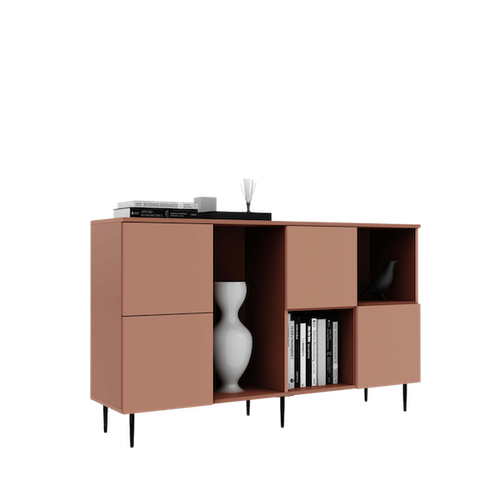
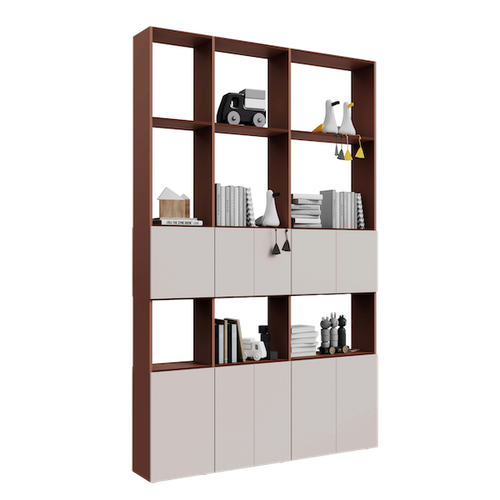
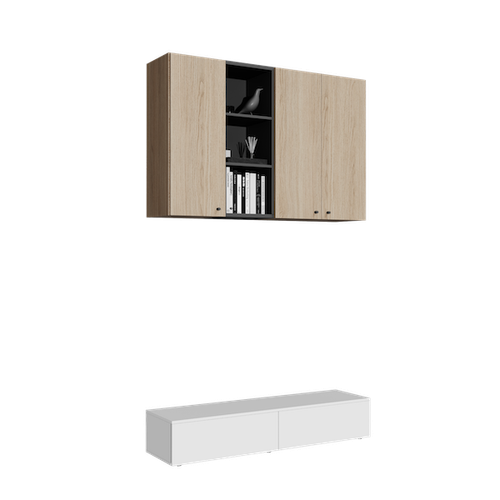
A 3D configurator eliminates uncertainty from the selection process. You can test different dimensions, compare materials and visualize compartmentalization — all without leaving home. At Téchne, the price updates in real time as you modify each option, so there are no surprises at the end. You can configure wardrobes and dressing rooms, sideboards, room dividers or wall cabinets — each with the same customization options. Moreover, the system is designed to prevent mistakes: it won't let you select impossible dimensions or incompatible material combinations.
Configure your wardrobe now and see the price in real time