
Chipboard vs MDF: What's the Difference and What to Choose for Custom Furniture?
Compare melamine chipboard and painted MDF: durability, price, look, moisture resistance. Find out which material is right for your furniture.
When configuring custom furniture, one of the first decisions is choosing the material. Melamine chipboard and MDF are the two main options. Each has distinct advantages, and the right choice depends on usage, budget and aesthetic preferences.
What Is Melamine Chipboard?
Chipboard is a composite material made from wood chips pressed and bonded with special resins, then covered with a melamine layer. Melamine is an extremely scratch, stain and surface moisture resistant decorative film.
Chipboard characteristics:
- Available in hundreds of colors and textures (wood, solid, concrete, marble)
- Good resistance to scratches and daily wear
- Accessible price — the most used material in the furniture industry
- Medium weight — easy to transport and install
- Standard thicknesses: 18 mm (bodies) and 25 mm (tops)
What Is MDF?
MDF (Medium Density Fibreboard) is made from fine wood fibers pressed at high temperature and pressure. The result is a uniform board, without visible knots or chips, with a perfectly smooth surface.
MDF characteristics:
- Perfectly smooth surface — ideal for painting in any RAL color
- Allows milling and profiling (rounded edges, decorative grooves)
- Better bending resistance than chipboard
- Heavier than chipboard (higher density)
- 30-50% more expensive than melamine chipboard
Direct Comparison: Chipboard vs MDF
Scratch resistance: Melamine chipboard wins — the melamine layer is extremely hard. Painted MDF can be more sensitive to scratches, depending on the type of lacquer applied.
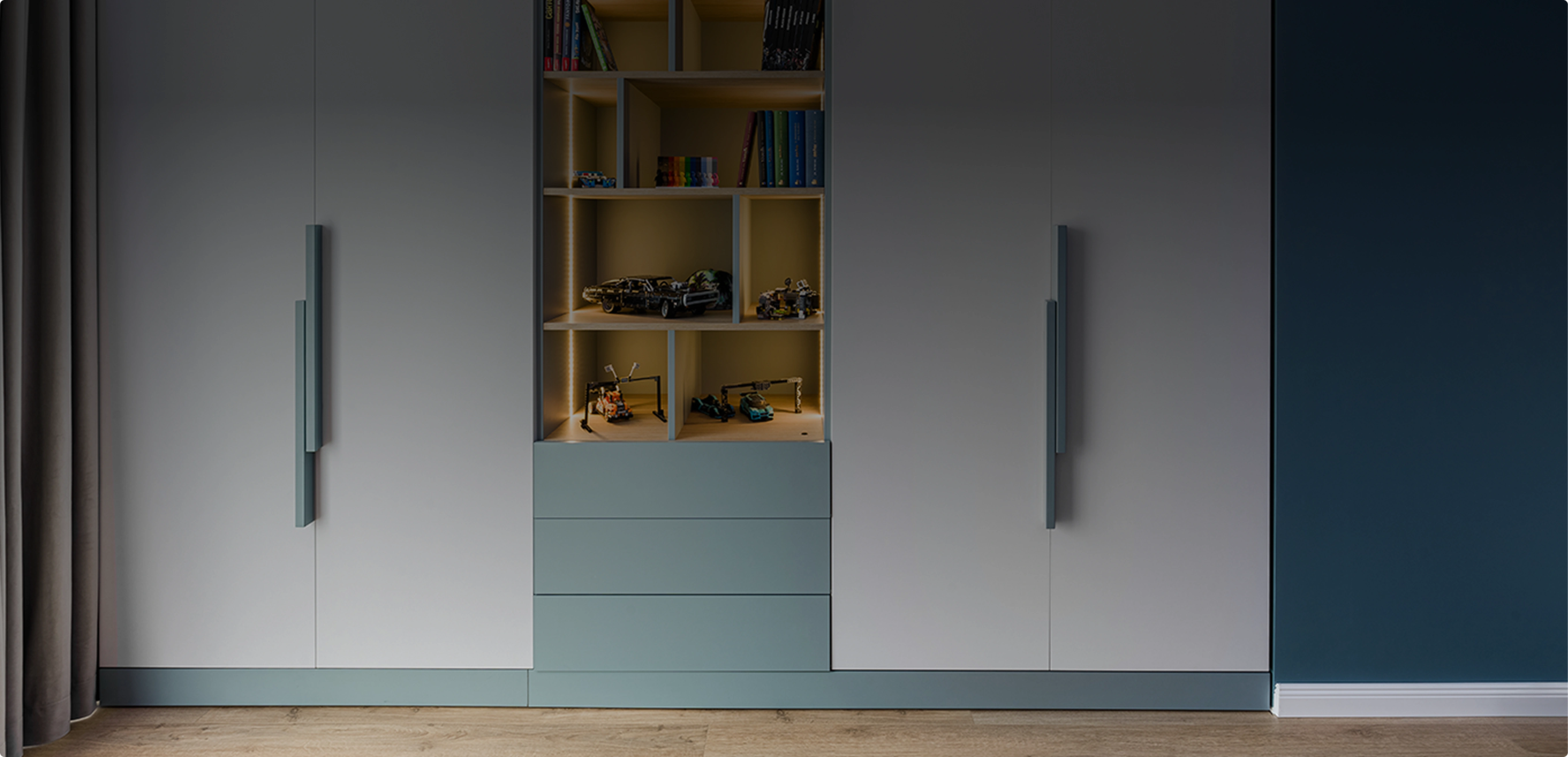
Visual appearance: MDF offers a superior finish — perfectly flat surface, no visible texture, ideal for modern styles with solid colors. Melamine chipboard excels at wood imitations and decorative textures.
Moisture resistance: Both materials are sensitive to excessive moisture. Chipboard swells irreversibly if water penetrates the structure. MDF resists somewhat better, but it's also not recommended for high-humidity areas (bathroom) without additional protection.
Price: Melamine chipboard is 30-50% cheaper than painted MDF. For a 200 cm wardrobe, the difference can be 1,000-2,000 RON.
Durability: Both last 15-20+ years under normal usage conditions with quality hardware.
When to Choose Melamine Chipboard?
- Controlled budget without quality compromises
- You want realistic wood textures (oak, walnut, ash)
- Cabinet bodies and interiors (not visible anyway)
- Furniture for bedroom, hallway, living room
When to Choose MDF?
- Solid color fronts (matte white, anthracite gray, RAL colors)
- Modern, minimalist design with no visible texture
- Special profiles on fronts (grooves, rounded edges)
- More generous budget, priority on appearance
Optimal Solution: Chipboard + MDF Combination
Many customers choose a combination: chipboard body (for cost and durability) and painted MDF fronts (for premium appearance). This approach offers the best balance between price and aesthetics.
With an online configurator, you can choose the material for each component separately and immediately see how it affects the price and final look.
Compare materials in the configurator
When to Use Each Material: The Practical Rule
Industry experience has crystallized a simple rule that works in 90% of cases:
- Body (carcass) = melamine chipboard — excellent structural resistance, optimized cost, not visible anyway (covered by fronts and accessories). It makes no economic or practical sense to use MDF for a wardrobe's interior.
- Fronts (doors) = melamine chipboard OR MDF — if you want wood textures or standard decors, melamine chipboard is ideal. If you want a solid color (matte white, anthracite gray, black, or any other RAL color), painted MDF is the correct choice, as it offers a perfectly flat surface with no visible texture. At Téchne, you can choose front material independently from the body, directly in the configurator.
- Tops — for sideboards and wall cabinets, 25 mm chipboard tops are standard. MDF is an option for tops with special shapes (rounded, profiled).
Thickness Matters: 18 mm as Minimum Standard at Téchne
Not all chipboard panels are equal. The standard thickness in quality furniture is 18 mm — this provides:
- Structural rigidity — an 18 mm chipboard shelf supports 15-20 kg per linear meter without visible long-term deformation. The same shelf in 15 mm chipboard visibly bows under the same load after 1-2 years.
- Connector resistance — 18 mm thickness allows solid anchoring of metal connectors and hinges. At 15 mm, the material can fail around fixing points.
- Superior acoustics — a thicker panel transmits less sound — the difference is noticeable when closing doors.
At Téchne, 18 mm is the minimum thickness for all bodies, regardless of furniture type — wardrobes, sideboards, room dividers or wall cabinets. This standard is non-negotiable because 15-20 year durability depends directly on panel structural quality.
Surface Treatments: Melamine, PUR Lacquer and Special Finishes
The material's surface determines the look, resistance and feel:
- Melamine (on chipboard) — thermally fused decorative layer, extremely scratch-resistant (class 4-5 on the Mohs scale). Available in varied textures: smooth (Smooth), wood pore (Pore), fiber structure (Textile), deep matte (Supermatt). At Téchne, over 200 decors from Egger and Kronospan are available.
- Polyurethane PUR lacquer (on MDF) — applied in 3-4 layers with intermediate sanding. The result is a perfectly uniform surface with no joint lines. Available in Soft Touch (matte velvety, fingerprint-resistant) and High Gloss (mirror-like gloss) variants. 49 RAL/NCS colors available at Téchne.
- Milled ribbing (on MDF) — parallel vertical grooves milled into the MDF surface, then painted. Provides a three-dimensional decorative effect, associated with contemporary premium design.
ABS Edge Banding with Polyurethane Adhesive: Why It Matters
Edge banding is the protective strip applied to cut panel margins. At first glance it seems like a minor detail, but it directly influences durability:
- 2 mm ABS edge with PUR adhesive — standard at Téchne. Polyurethane adhesive is thermally activated and forms a permanent chemical bond with the board. The result: the edge doesn't peel even at high humidity or temperature variations. The appearance is seamless — the bond line is practically invisible.
- 0.4-1 mm PVC edge with EVA (hot-melt) adhesive — common in budget furniture. EVA adhesive melts with heat and stiffens with cold, meaning the bond weakens over time. After 2-4 years, the edge starts lifting at corners and exposed margins — especially in kitchens and bathrooms where humidity is higher.
The cost difference between the two variants is ~5-10% of the total furniture price, but the impact on durability is significant: ABS+PUR edge banding keeps furniture looking new for 15-20 years, while PVC+EVA looks worn after 3-5 years.
Moisture Resistance: Practical Differences
Neither chipboard nor MDF are waterproof materials. Both are wood-based and react to water. However, their behavior differs:
- Melamine chipboard — the melamine layer protects the surface, but if water reaches the internal structure (through unprotected edges or cutouts), chipboard swells irreversibly. This is why quality ABS edge banding is essential — it completely seals cut edges.
- MDF — being denser and more uniform, MDF absorbs water more slowly than chipboard. However, once wet, MDF deforms and loses its structure. MDF's advantage is that the polyurethane (PUR) lacquer forms a waterproof layer on the surface.
Recommendation: For areas with moderate humidity (bedroom, living room, hallway), both materials work excellently with standard protection. For bathrooms or kitchens, ensure all edges are protected with ABS banding and there are no uncovered cutouts. Adequate ventilation is essential in both cases — don't place furniture directly against a cold exterior wall where condensation can form. In the Téchne configurator, you select the desired material and the system automatically shows only compatible options — it won't let you choose combinations that don't work structurally.