
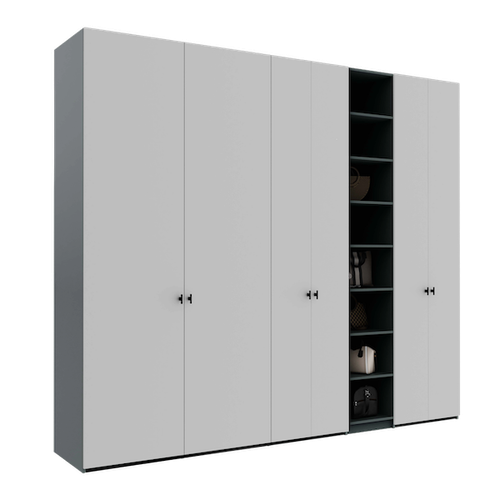
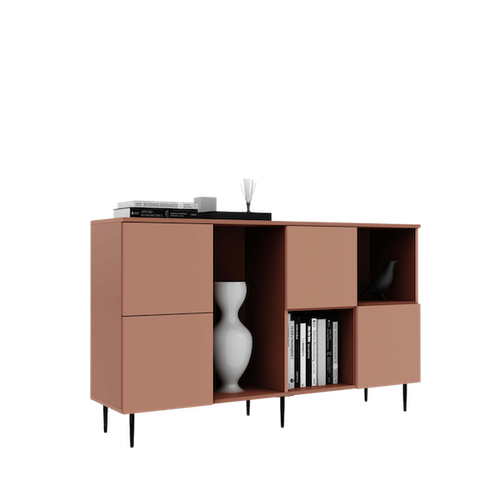
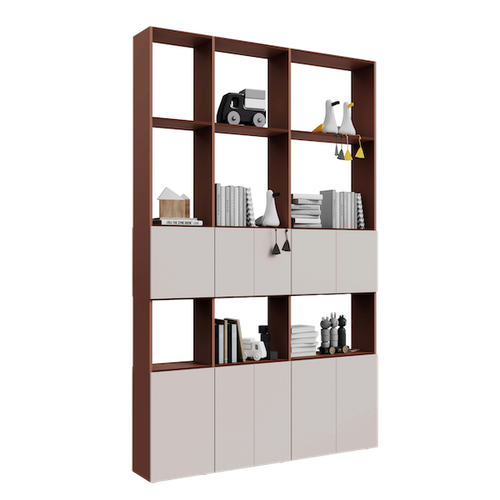
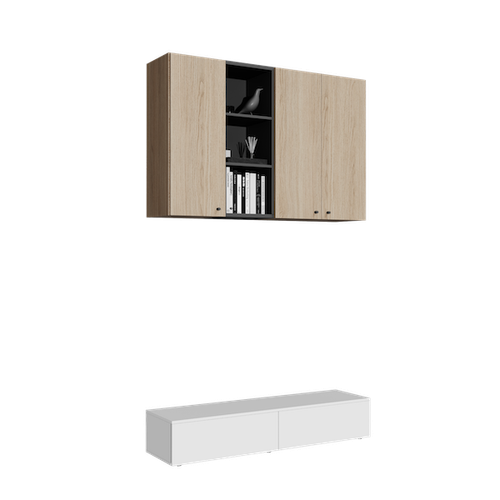
How to choose handles and knobs for custom furniture
Guide to handle types for custom furniture: knobs B1-B4, standard handles M1-M6, edge pulls P1-P3, push-to-open. Materials, styles and matching tips.
Handles and knobs are the detail that defines the personality of a wardrobe, chest of drawers, or any piece of furniture. The wrong choice can disrupt the harmony of an entire room, while the right one transforms a utilitarian piece into something with character. In this guide, we walk through every handle type available in the Techne configurator -- from discreet knobs to fully invisible push-to-open systems -- and explain when each type works best.
Knobs (B1-B4) -- simplicity and elegance
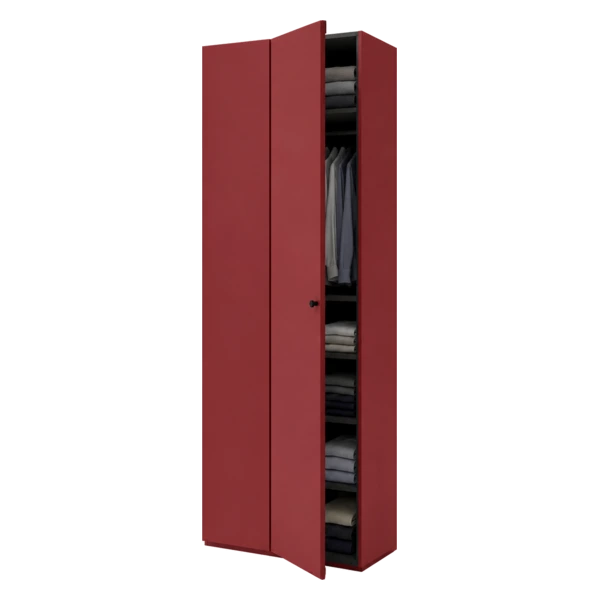
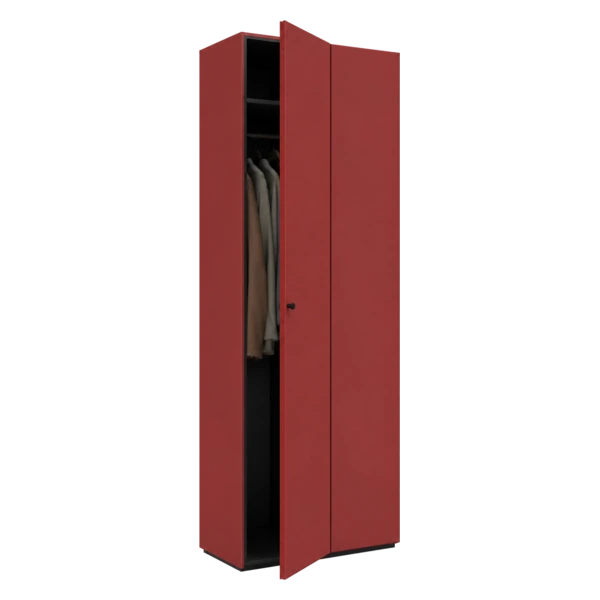
Knobs are the most compact gripping option. They occupy a single point on the door and are ideal for bedroom furniture, living rooms, and children's rooms where a clean look is the priority.
- B1 -- small cylindrical knob (10 mm diameter): discreet, suited for chests of drawers and bedside tables. Works excellently on small doors under 40 cm wide.
- B2 -- classic round knob (25 mm diameter): the most popular model, comfortable to grip. Ideal for everyday wardrobes and bookcases.
- B3 -- square knob (25 x 25 mm): a geometric accent suited to modern and minimalist styles. Looks striking on fluted MDF doors.
- B4 -- mushroom knob (30 mm diameter): rounded and ergonomic. Recommended for kitchens and bathrooms where hands may be wet.
Knobs are typically mounted at 90-100 cm from the floor on tall doors and at the centre of the door on smaller ones (drawers, cabinet doors).
Standard handles (M1-M6) -- versatility and comfort
Standard handles are horizontal or vertical bars fixed at two points. They offer a firm grip and are the most common choice for bedroom and dressing room furniture.
- M1 -- slim bar (hole spacing: 96 mm): compact, ideal for drawers and small doors up to 50 cm.
- M2 -- slim long bar (hole spacing: 128 mm): the most popular size for standard wardrobe doors.
- M3 -- arched bar (hole spacing: 128 mm): curved profile, comfortable to grip. A classic choice that fits any interior.
- M4 -- wide bar (hole spacing: 160 mm): substantial, with a rectangular cross-section. Works well on larger doors from 60 cm width upward.
- M5 -- extra-wide bar (hole spacing: 192 mm): for statement pieces. Impressive on hallway wardrobes and generous dressing rooms.
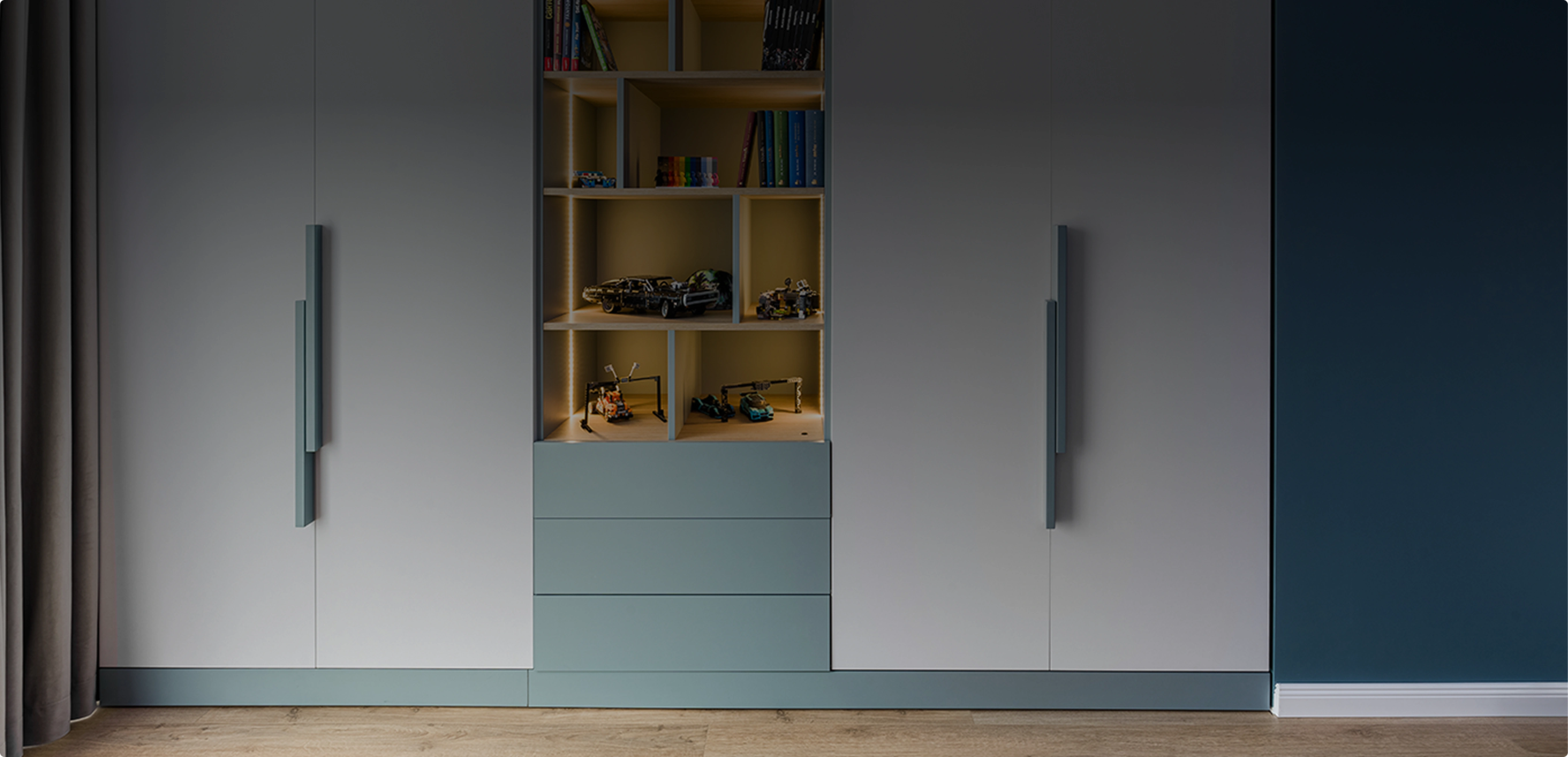
- M6 -- long vertical handle (hole spacing: 320 mm): mounted vertically along the gripping zone. Dramatic effect, recommended on tall dressing room doors.
The basic rule: the larger the door, the longer the handle can be. An M1 on an 80 cm door looks lost; an M5 on a 40 cm door looks disproportionate.
Edge pulls / profiles (P1-P3) -- maximum discretion
Edge pulls are integrated into the edge of the door and do not project beyond the front surface. They are the ideal solution for anyone who wants a completely clean look with nothing protruding from the door plane.
- P1 -- J-profile: a subtle channel routed into the top or side edge of the door. Your fingers grip the door from the inside. The most discreet handle possible.
- P2 -- bonded aluminium profile: an anodised aluminium bar bonded to the door edge. Provides a subtle metallic accent and comfortable grip.
- P3 -- Gola profile: a continuous channel mounted below the top panel or between two adjacent doors. Creates a horizontal line that visually organises the entire piece of furniture.
Edge pulls are especially recommended for modern kitchens, minimalist bedrooms, and any space where you want the furniture to blend seamlessly into the wall.
Push-to-open -- no visible handles
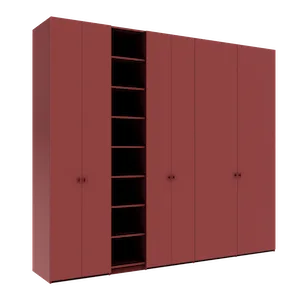
The push-to-open system eliminates handles entirely. You press the door and a spring mechanism opens it. To close, press again and the door returns to position.
Advantages:
- Completely smooth appearance with no visual interruption
- Ideal for floating cabinets and minimalist chests of drawers
- Works on hinged doors and drawers alike
Considerations:
- Push-to-open doors can show fingerprints on the surface -- Soft Touch (ultra-matte) finishes are more fingerprint-resistant than High Gloss
- Not recommended for very heavy doors (over 8 kg) or very wide ones (over 60 cm) -- the mechanism loses effectiveness
In the configurator, push-to-open is available as a door option and can be combined with any front finish.
Materials and finishes for handles
The handle material affects both aesthetics and durability. Here are the main options:
- Polished chrome -- classic and shiny. Pairs well with white or light grey furniture. Requires regular cleaning to avoid water spots.
- Matte black -- the dominant trend in interior design. Works brilliantly with oak, walnut, and earthy tones. Does not show fingerprints.
- Gold (brass) -- adds warmth and a premium feel. The combination with deep green, navy blue, or cream white fronts creates a striking effect.
- Anodised aluminium -- neutral, durable, affordable. The most versatile material, fitting any colour palette.
- Brushed stainless steel -- robust, suitable for bathrooms and kitchens. Resistant to moisture and corrosion.
How to match handles with room style
A few tested and recommended combinations:
- Modern bedroom: edge pulls P1/P2 or push-to-open, matte black or aluminium finish
- Generous dressing room: handles M4/M5/M6 in matte black, mounted vertically on tall doors
- Children's room: knobs B2/B4 in cheerful colours or chrome -- easy to grip with small hands
- Entrance hallway: Gola profile (P3) for an integrated look, or arched M3 handles for a classic feel
- Living room: square B3 knobs for geometric minimalism, or P1 for total discretion
Practical selection tips
Regardless of the type you choose, keep these points in mind:
- Test the grip: a handle that looks good but is uncomfortable to grasp will become frustrating in daily use.
- Consistency: use the same handle model on all doors in a room. You can vary the size (M2 on small doors, M4 on large ones), but keep the same line.
- Maintenance: in bathrooms and kitchens, choose moisture-resistant materials (stainless steel, anodised aluminium). Avoid polished chrome in wet areas.
- Small children: push-to-open on wall-mounted cabinets eliminates snagging risks. Rounded knobs (B2, B4) are safer than those with sharp corners.
The Techne configurator lets you preview every handle type on your piece of furniture in real time. Head to the 3D configurator, choose the shape of your wardrobe, then experiment with knobs, handles, or push-to-open until you find the perfect combination. A small detail makes a big difference.