
Furniture legs and castors: a buying guide for 2026
Heights from 50 to 170 mm, chrome or matt black, adjustable kitchen legs and D30–D50 castors. How to choose and how many to fit, with Téchne collection prices.
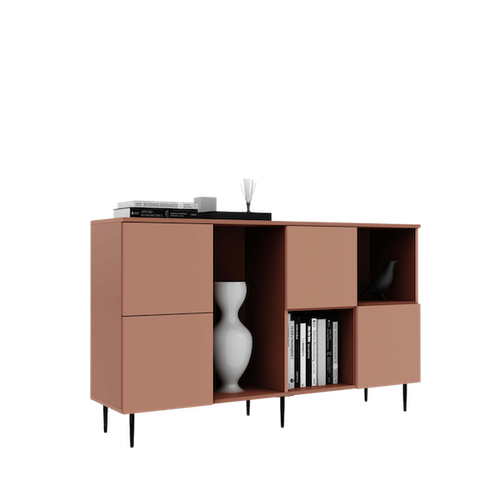
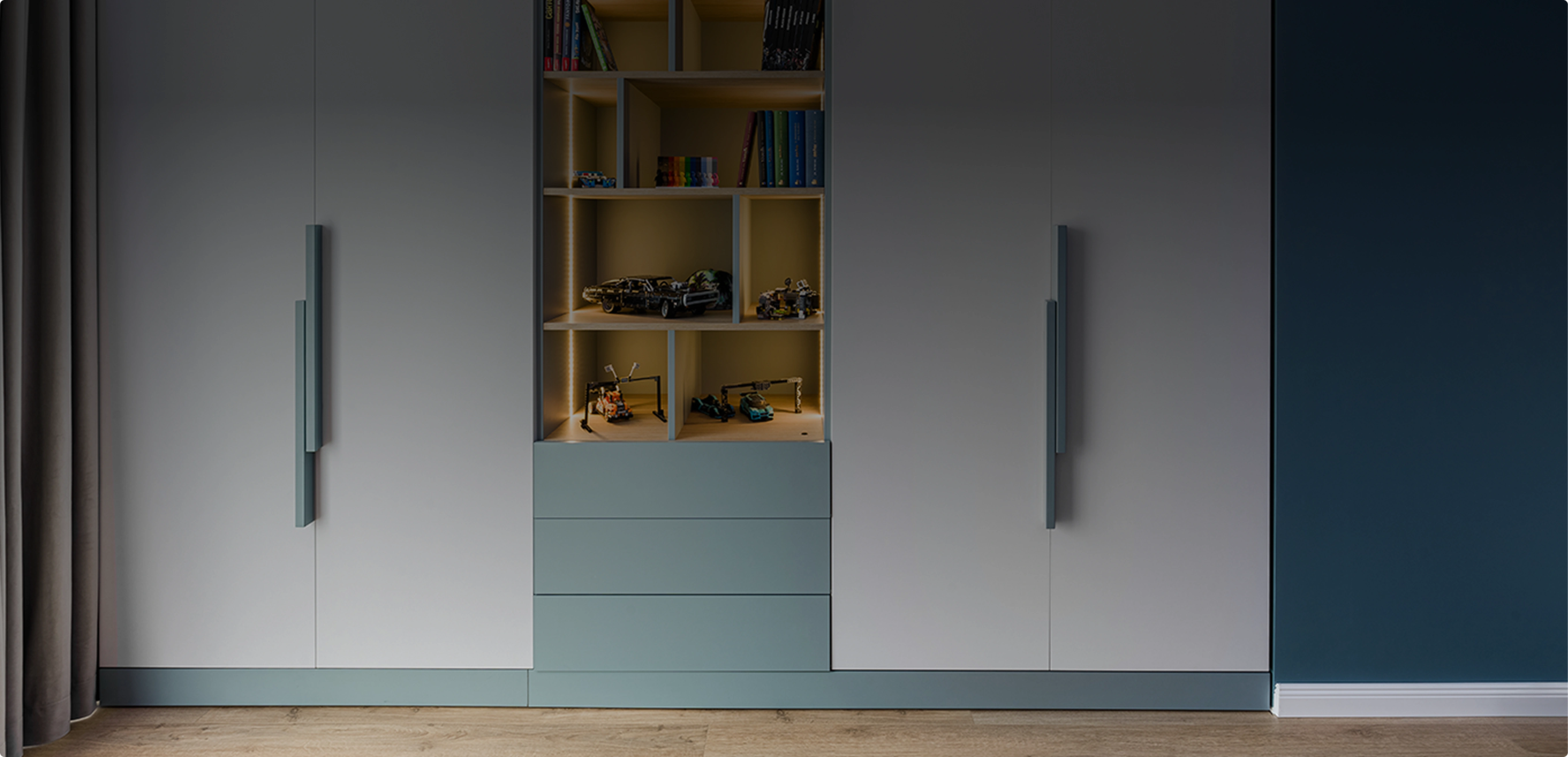
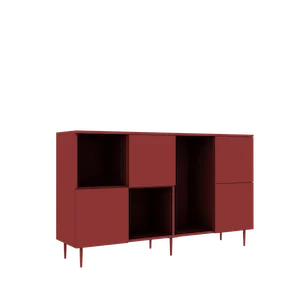
The same cabinet placed straight on the floor and lifted on 13 cm legs looks like two different pieces. The first seems massive, anchored, part of the wall; the second seems light, floating slightly above the floor, with a shadow that lets the room breathe. In the Téchne furniture legs collection, that difference costs between 4.90 and 16.48 lei per piece.
Why lift furniture off the floor
- Cleaning. A vacuum and a mop fit under a unit raised by 10 cm. Under one sitting flat on the floor, dust collects where you cannot reach without moving the furniture.
- Moisture. In a bathroom, a kitchen or on the ground floor, a centimetre of air between the board and the floor protects the bottom edge — the most vulnerable part of any cabinet.
- Uneven floors. A floor is rarely perfectly flat. Adjustable legs absorb the difference without wedges under the carcass.
- Appearance. Raised furniture looks lighter and makes a room feel bigger — especially useful in small spaces.
Available heights: from 50 to 170 mm
The collection covers a full range of heights, and the choice is not only aesthetic:
- 50 mm (Riex GS25, matt chrome) — a discreet lift for low sideboards and living-room units. Barely visible, but it solves the cleaning problem.
- 100 mm (Riex GS23 round D30 chrome, GS26 square 25×25 mm chrome or matt black) — the classic height for sideboards and living-room units. A vacuum fits underneath and the silhouette stays balanced.
- 130 mm (Riex GS42 and GS43, matt black) — the "furniture on legs" proportion, the one immediately read as a design decision.
- 150 mm (Riex GS49 matt black, GS23 round chrome, GS26 square matt chrome) — for tall units or for a pronounced Scandinavian feel.
- 170 mm (Riex GS52 and GS53, matt black) — the tallest in the collection, right when you want the space under the furniture to become part of the composition.
A practical rule: the wider and heavier the unit, the more a very tall leg makes it look unstable. On a sideboard wider than 180 cm, 100–130 mm is the safe zone.
Shape and finish: round, square, chrome or matt black
The collection offers two geometries and three finishes, and their combination completely changes the character of the furniture.
- Round D30 (GS23 series, chrome) — a slim profile, almost invisible from the side. It works with light-coloured furniture and the Scandinavian style.
- Square 25×25 mm (GS26 series, chrome or matt chrome) — a straight line continuing the edge of the carcass. It suits flat fronts and handles in the same finish.
- Matt black (GS42, GS43, GS49, GS52, GS53) — the most requested finish right now. Under a light unit it draws a graphic outline; under a dark one it almost disappears.
A note on coherence: pick leg finishes from the same family as your handles and wardrobe rails. Three different metals in one room are noticeable, even when you cannot say at first glance why something feels off.
The adjustable kitchen leg
Riex GK50 is a different animal: a three-part adjustable leg, 150 mm, with a −25/+45 mm adjustment range. It is never seen — it hides behind the plinth — and it solves the problem almost every kitchen has: a floor that drops two centimetres along the run of the units. At 5.38 lei apiece it is the cheapest insurance against a worktop that does not come out level.
Use it anywhere you have a run of units that must align perfectly with each other: kitchen, utility room, balcony cupboards.
Castors: when furniture has to move
The castors collection holds four Riex GC10 variants, all black and all at 4.90 lei:
- D30, 38×38×1.5 mm mounting plate — for small, light units: storage boxes, office pedestals, drawer boxes.
- D40, 42×42×2 mm plate — the middle step, the most versatile.
- D50, 42×42×2 mm plate — a larger wheel rolls more easily over thresholds, rugs and joints.
- D50 with brake, 42×42×2 mm plate — the same wheel, with a lock.
Three fitting rules worth remembering:
- At least two braked castors on anything that moves. A unit on four free wheels rolls away the moment you touch it.
- Diameter follows the floor. On parquet and tiles, D30 is enough. On carpet or wide joints, move up to D50.
- The wheel adds height. Measure the unit with the castors fitted before you configure it — a drawer pedestal meant to slide under a desk no longer fits with 5 cm extra.
How many legs per unit
Four legs cover ordinary units up to 120 cm wide. Above 120 cm, add a fifth in the middle of the front edge — a long base sags in the middle under load, and the more you fill the unit the more visible it becomes. Above 180 cm, use two intermediate legs.
Position them set back 5–7 cm from the front edge, so you do not catch your foot on them and the shadow stays clean. Choose fixing screws shorter than the thickness of the base, so they do not pierce the bottom panel — you will find what you need in the screws and fixings section.
The alternative: a wall-hung unit
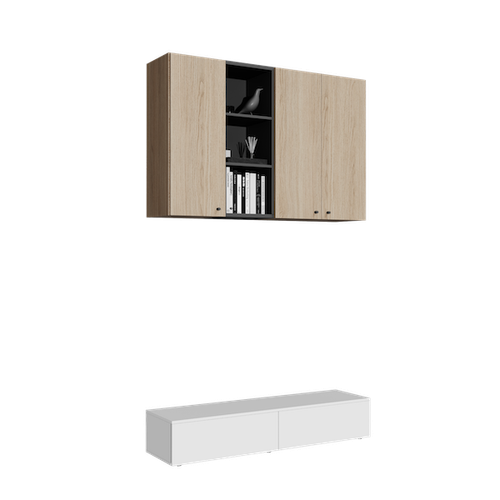
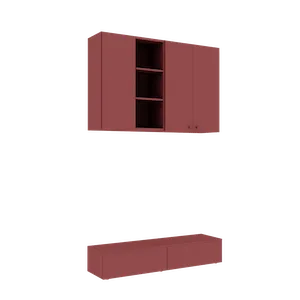
If cleaning is the reason you are lifting the furniture, there is another route: the wall-hung unit, fixed straight into the wall with no contact with the floor at all. It gives the cleanest look, but it needs a wall that can carry the weight and careful positioning relative to sockets. Choose legs when you want flexibility and easy moving, wall mounting when you want the airiest possible result.
Every part in this guide is in stock and can be ordered separately from the furniture, in the hardware section.