
Wall Cabinet in the Bathroom — Humidity-Resistant Materials
Complete guide for bathroom wall cabinets: moisture-resistant materials (moisture-proof chipboard, painted MDF), mounting on tiled walls, ventilation, and optimal dimensions.
The bathroom is one of the most challenging rooms for furniture — high humidity, sudden temperature changes, frequent contact with water and steam. A wall-mounted cabinet in the bathroom must withstand these conditions without swelling, warping, or losing its appearance. In this guide, we focus exclusively on the bathroom-specific challenges and the materials suited for this environment.
If you are interested in wall cabinets in general — uses, mounting on different wall types, design — consult the complete guide to wall-mounted cabinets. Here, the emphasis is on moisture resistance and the specifics of bathroom installation.
Why Is the Bathroom Different from the Rest of the Home?
In a bedroom or living room, relative humidity is usually 40-60%. In the bathroom, after a hot shower, humidity can rise to 80-95% for 15-30 minutes. This daily fluctuation, repeated over years, is the primary enemy of furniture:
- Moisture absorption — wood-based materials (chipboard, MDF) absorb moisture through unprotected surfaces, especially through edges and mounting holes
- Swell-dry cycles — repeated absorption and release of moisture causes progressive material swelling, panel warping, and edge detachment
- Condensation — on cold surfaces (exterior wall, cold water pipes), condensate forms and runs onto furniture, penetrating through any crack in the surface protection
- Direct splashing — in small bathrooms, the sink, bathtub, or shower are close to furniture, and water droplets frequently reach surfaces
The conclusion: bathroom furniture must not just look good — it must withstand an aggressive environment, day after day, year after year.
Suitable Materials for Bathroom Wall Cabinets
Moisture-Proof Chipboard (Humidity Resistant)
Moisture-proof chipboard (also known as V313 chipboard or green chipboard — due to the green-colored core for identification) is standard chipboard with special water-resistant resins added during manufacturing. The differences compared to standard chipboard:
- Reduced water absorption — moisture-proof chipboard absorbs 30-50% less water than standard chipboard under the same conditions. It is not waterproof, but resists ambient humidity significantly better.
- Slower swelling — even when exposed to moisture, swelling is much slower and more limited, providing time for ventilation and drying
- Price — approximately 15-25% more expensive than standard chipboard, a modest difference for the protection offered
Important: Moisture-proof chipboard is NOT waterproof. It cannot be submerged in water or exposed to a direct water jet without consequences. It is designed to withstand high ambient humidity and occasional water contact — exactly the conditions in a well-ventilated bathroom.
Painted MDF — Complete Surface Barrier
MDF painted with polyurethane lacquer creates a continuous physical barrier on the panel surface. Unlike melamine (which has micro-porosities at joints), polyurethane lacquer uniformly covers the entire surface, including edges, forming a waterproof layer.
Advantages for bathrooms:
- Surface waterproofing — water sits on the surface without penetrating, similar to tiles
- Easy cleaning — wipes clean with any bathroom cleaner (non-abrasive)
- Steam resistance — steam does not penetrate through the polyurethane lacquer
- Premium aesthetics — the solid-color finish, available in 49 RAL/NCS colors, integrates elegantly into any bathroom
Disadvantages: the price is higher than laminated chipboard, and any lacquer damage (deep scratch, chip) exposes the unprotected MDF, which is more sensitive to water than moisture-proof chipboard.
Standard Laminated Chipboard — With Precautions
Standard laminated chipboard is not the first choice for bathrooms, but can be used with additional precautions:
- ABS edging applied with polyurethane adhesives on ALL edges — no unprotected edges, including non-exposed edges (wall-side, top, bottom). The polyurethane adhesive is moisture-resistant and hermetically seals the chipboard core. We tested this: a panel submerged in water for 24 hours showed no swelling of the inner core.
- Silicone sealing — on all joints, especially the wall contact zone
- Mandatory ventilation — the cabinet door must allow air circulation (no hermetic sealing)
- Strategic positioning — as far as possible from the water source and splash zone
Under these conditions, standard laminated chipboard can last 8-12 years in a ventilated bathroom. With moisture-proof chipboard, the same lifespan extends to 15-20 years.
Mounting on the Bathroom Wall
Mounting wall cabinets in bathrooms has specific challenges:
Tiled Walls
Most bathrooms have walls clad with tiles. This adds an extra layer (tile thickness + adhesive = 10-15 mm) that must be traversed before reaching the structural wall.
- Tile drill bit — a special drill bit with a tungsten carbide tip is used to perforate the tile without cracking it. Low speed, no hammer action.
- Structural wall anchoring — after traversing the tile, switch to hammer drill mode and anchor the plug in the structural wall behind (concrete, brick). The plug must penetrate at least 4-5 cm into the structural wall.
- Cabinet weight — a bathroom wall cabinet, filled with towels and cosmetic products, can weigh 25-40 kg. Use metal expansion anchors for concrete or Fischer Duopower anchors for brick.
Drywall (Plasterboard) Walls
In renovated bathrooms, walls may be moisture-resistant drywall (green board). Here, fixing is more delicate:
- Special drywall anchors — Molly type or butterfly type, which open behind the board and distribute the load over a larger area
- Weight limit — a drywall anchor supports 15-25 kg. For heavy cabinets, anchoring into the metal profiles behind the drywall or mounting a reinforcement board (OSB or plywood) behind the drywall is necessary
- Pre-check — use a metal profile detector to find the structure behind the board and anchor into it
Distance from Water Source
The general rule: the wall cabinet should be mounted at least 60 cm from any direct water source (sink, bathtub, shower). This distance significantly reduces exposure to splashes and direct jets.
What to Store in a Bathroom Wall Cabinet
A bathroom wall cabinet serves a different type of storage than a bedroom wardrobe. Typical contents:
- Towels — 2-4 folded towels on shelves. A shelf 30 cm deep and 60 cm wide accommodates 3-4 towels folded in standard format
- Cosmetics and hygiene products — creams, shampoo, shower gel, toothbrushes, toothpaste. Ideally on a shelf at eye height, visible and accessible
- Cleaning supplies — detergents, bathroom solutions, sponges. Ideally on the lowest shelf, hidden behind the door
- Medications and first aid kit — on an upper shelf, inaccessible to children
- Reserves — toilet paper, spare soap, consumables. On the topmost or bottommost shelf
Ventilation: The Key to Longevity
The most important factor for furniture durability in the bathroom is not the material — it is ventilation. A wall cabinet made from standard chipboard in a well-ventilated bathroom lasts longer than one made from moisture-proof chipboard in a bathroom without ventilation.
Ventilation tips:
- Bathroom fan — mandatory if the bathroom has no window. A fan with a humidity sensor starts automatically when humidity exceeds 70%.
- Gap between cabinet and wall — leave 5-10 mm between the cabinet back and the wall (spacer). This allows air to circulate and prevents condensation from forming on the cabinet back.
- Do not seal the cabinet hermetically — a cabinet without doors or with ventilation-slotted doors allows faster drying of both contents and interior.
- Ventilate after showering — open the bathroom door or turn on the fan after each shower. 15 minutes of ventilation dramatically reduces humidity.
Typical Dimensions for Bathrooms
Bathrooms are usually smaller than bedrooms or living rooms, so wall cabinet dimensions must be adapted:
- Width — 40-80 cm (most popular: 60 cm, which fits above a standard sink)
- Height — 40-80 cm (a 60 cm tall cabinet provides 2-3 usable shelves)
- Depth — 20-35 cm (smaller than a living room or bedroom cabinet, so it does not protrude too far from the wall and does not impede movement in the bathroom's tight space)
In the Téchne configurator, you can set each dimension to the exact centimeter — ideal for bathrooms with niches, corners, or atypical spaces where a standard cabinet does not fit.
Recommended Finishes for Bathrooms
Not all finishes behave the same in humid conditions:
- Matte white or light grey — the most popular for bathrooms. Water stains are less visible than on dark surfaces. Matte finish (vs glossy) better conceals splash marks.
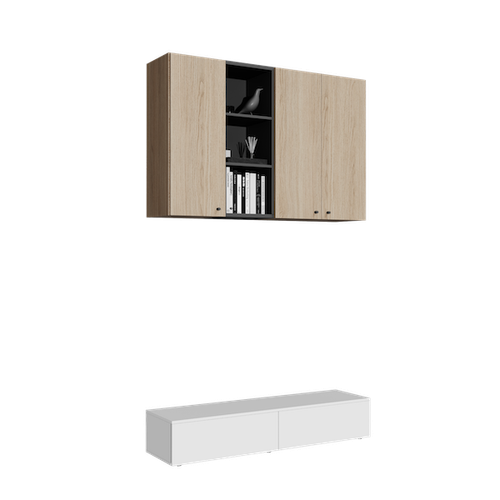
- Light wood decor (white oak, ash) — adds warmth to the classic white-grey bathroom. Synchronized texture masks potential imperfections.
- Painted MDF Soft Touch — velvety finish that does not retain fingerprints and water stains. Premium, but ideal for small bathroom cabinets where the per-piece budget is higher.
- Avoid: High Gloss finish in bathrooms — the glossy surface looks superb when clean, but reveals every water drop, toothpaste spot, or fingerprint. Requires daily cleaning.
How to Configure a Bathroom Wall Cabinet in the Téchne Configurator
The Téchne wall cabinet configurator lets you design the ideal cabinet for your bathroom:
- Set dimensions — width, height, and depth to the exact centimeter, adapted to your bathroom's available space
- Choose material — laminated chipboard (with the recommendation to request moisture-proof chipboard at order) or painted MDF for maximum protection
- Configure interior — number and position of shelves, adapted for what you store
- Choose doors — with door (clean look, contents protected from splashes) or without door (natural ventilation, quick access)
- Visualize in 3D — rotate the model, check proportions, and compare with your bathroom space
- Download 3D model — verify dimensions in your real space before ordering
Production time is 2-3 weeks, with professional delivery and installation. The installation team has experience with tile-wall mounting and verifies anchor solidity before leaving the cabinet installed.
Periodic Maintenance
To maximize the lifespan of your bathroom wall cabinet:
- Weekly — wipe exterior surfaces with a damp cloth and mild detergent. Dry immediately.
- Monthly — check edges and joints for signs of swelling or detachment. Silicone re-sealing is done annually or as needed.
- Every six months — empty the cabinet and leave it open for a day for complete airing.
- As needed — if you notice mold signs (black spots in corners), clean with anti-mold solution and improve bathroom ventilation.
Conclusion
A wall cabinet in the bathroom is an excellent storage solution — it frees up floor space, keeps items organized, and adds a design accent. The key to success is choosing the right materials (moisture-proof chipboard or painted MDF), correct mounting on the bathroom wall, and above all, adequate ventilation.
With the Téchne configurator, you get a wall cabinet designed to the exact dimensions of your bathroom, from materials selected for humidity resistance, with professional installation included. The intelligent system won't let you choose materials unsuitable for a humid environment — it shows only compatible options and validates every decision automatically.
Configure your bathroom wall cabinet now