
A shared wardrobe for two — how to split the space efficiently
How to organise a wardrobe for two people: dedicated zones, practical garment dimensions, and a sample 300 cm configuration with 6 columns.
A shared wardrobe is one of the most common home-organisation challenges. Two people with different wardrobes, different habits, and different storage needs must share a single space without major compromises. The good news is that with intelligent planning, a 300 cm wardrobe can comfortably accommodate two complete wardrobes. Here is how to approach each decision.
The dedicated-zone principle
The first rule is straightforward: each person gets their own zone. Do not split individual columns between partners — this creates chaos within the first two weeks. Establish a clear dividing line: the left side belongs to one person, the right side to the other. Or, if the wardrobe is placed in a corner, one person gets the front section and the other gets the side section.
This division does not have to be symmetrical. If one person has a significantly larger wardrobe (more dresses, suits, or seasonal items, for example), allocate them more columns. The goal is not mathematical equality but practical functionality.
The dimensions that matter
Before configuring the columns, you need to know how much vertical space each garment type requires when hung on a hanger:
Shirts, blazers, and blouses — need 105 cm of clear height. This is the short-hanging zone. A rail placed 110 cm above the shelf below provides the required space with a comfortable margin.
Dresses, overcoats, and long garments — need 160 cm of clear height. This is the long-hanging zone. A column dedicated entirely to long garments uses nearly the full usable height of the wardrobe.
Trousers on hangers — need 115 cm of clear height when hung at full length. If folded in half over the hanger, 65 cm is sufficient.
Folded clothes on shelves — a shelf every 30-35 cm in height is ideal. Less than 30 cm compresses the clothes; more than 35 cm wastes vertical space. For thick jumpers, go with 35 cm; for T-shirts and underwear, 30 cm is enough.
Drawers — ideal for accessories, underwear, socks, and small items. Interior drawers of 15-20 cm depth work perfectly for these categories. Place them in the lower section of the wardrobe for ergonomic access.
Symmetrical vs. asymmetrical layout
A symmetrical layout (3 columns + 3 columns) works when both people have similarly sized wardrobes. Each person receives the same internal configuration — for instance, one column with a long rail, one with a short rail and shelves below, and one with shelves and drawers. The advantage is simplicity: neither person feels they have less space.
An asymmetrical layout (2 columns + 4 columns, or any other split) is more practical when needs differ significantly. For example, if one person wears mainly suits and shirts (which need hanging rails) while the other prefers folded clothes (which need shelves), the internal configuration of the two zones will be fundamentally different.
Worked example: 300 cm wardrobe, 6 columns, 230 cm height
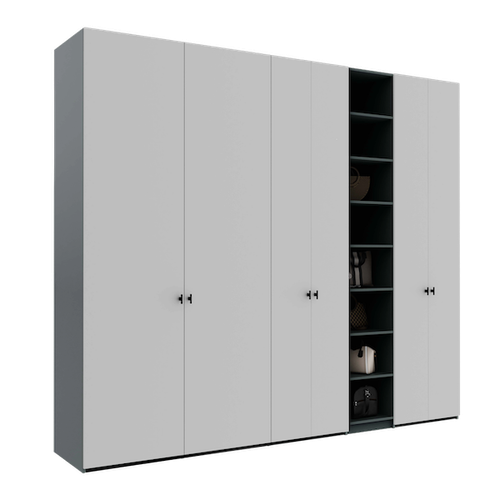
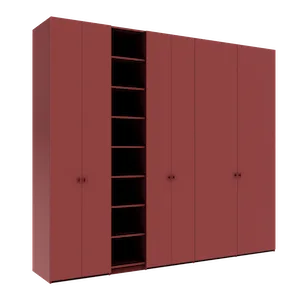
Here is a tested configuration that works for a standard couple. The wardrobe measures 300 cm wide, 230 cm tall, and 60 cm deep, divided into 6 columns of 50 cm each.
Person A's zone (columns 1-3, from the left):
Column 1 — long hanging rail (160 cm clear). Ideal for dresses, overcoats, or long garments. Below the rail, a base shelf for shoes or boxes.
Column 2 — short hanging rail at the top (105 cm), with 3 shelves below at 32 cm intervals. The rail holds shirts and blouses; the shelves hold folded clothes such as jumpers and T-shirts.
Column 3 — 5 shelves at 33 cm intervals plus 2 interior drawers at the bottom. The shelves for folded jeans, underwear organised in boxes; the drawers for accessories such as belts, scarves, and jewellery.
Person B's zone (columns 4-6, from the right):
Column 4 — identical layout to Column 3 (shelves + drawers). Practical for someone who prefers folded clothes.
Column 5 — short hanging rail at the top (105 cm) with 3 shelves below. For shirts, blazers, and folded trousers.
Column 6 — long hanging rail (160 cm) with a base shelf. For suits, overcoats, or full-length trousers.
This layout gives each person: one long-hanging zone, one short-hanging zone, shelves for folded items, and drawers for accessories. It is balanced but adjustable — for example, if Person A has no long garments, Column 1 can be reconfigured with a short rail at the top and extra shelves below.
Everyday practical tips
Label the shelves (at least mentally) during the first few weeks. Knowing that the third shelf is for jumpers and the fourth is for T-shirts prevents chaotic accumulation.
Seasonal rotation — use the top shelves (the hardest to reach) for off-season clothes. In winter, summer clothes go up; in summer, overcoats and thick jumpers move to the top shelves.
Interior drawers are more efficient than shelves for small items. A shelf with 20 pairs of socks tossed on it looks messy; a drawer with the same socks organised in rows looks impeccable and takes up less vertical space.
Leave a buffer — do not fill the wardrobe to 100% capacity. Leave at least 10-15% free space on shelves and hanging rails. This prevents crowding, allows clothes to breathe, and makes access much easier.
How door type affects organisation
The door type affects how you access each zone. Sliding doors (the most popular for dressing rooms) always cover part of the wardrobe — you cannot see all 6 columns at once. Therefore, place daily-use items in the central columns (2-3 and 4-5), which are the easiest to reach regardless of door position.
Hinged doors give simultaneous access to all columns but require space in front of the wardrobe for opening. If your dressing room has less than 100 cm of clear space in front of the wardrobe, sliding doors are the right choice.
Configure your shared wardrobe in our 3D configurator. Choose the number of columns, the internal compartment types, and the door style — see the result in real time and adjust until both partners are satisfied. It is simpler than it sounds.